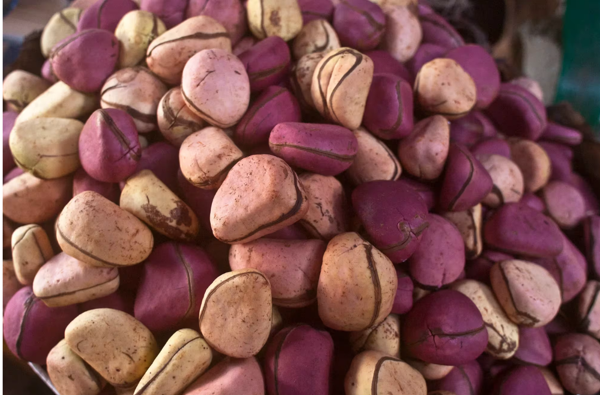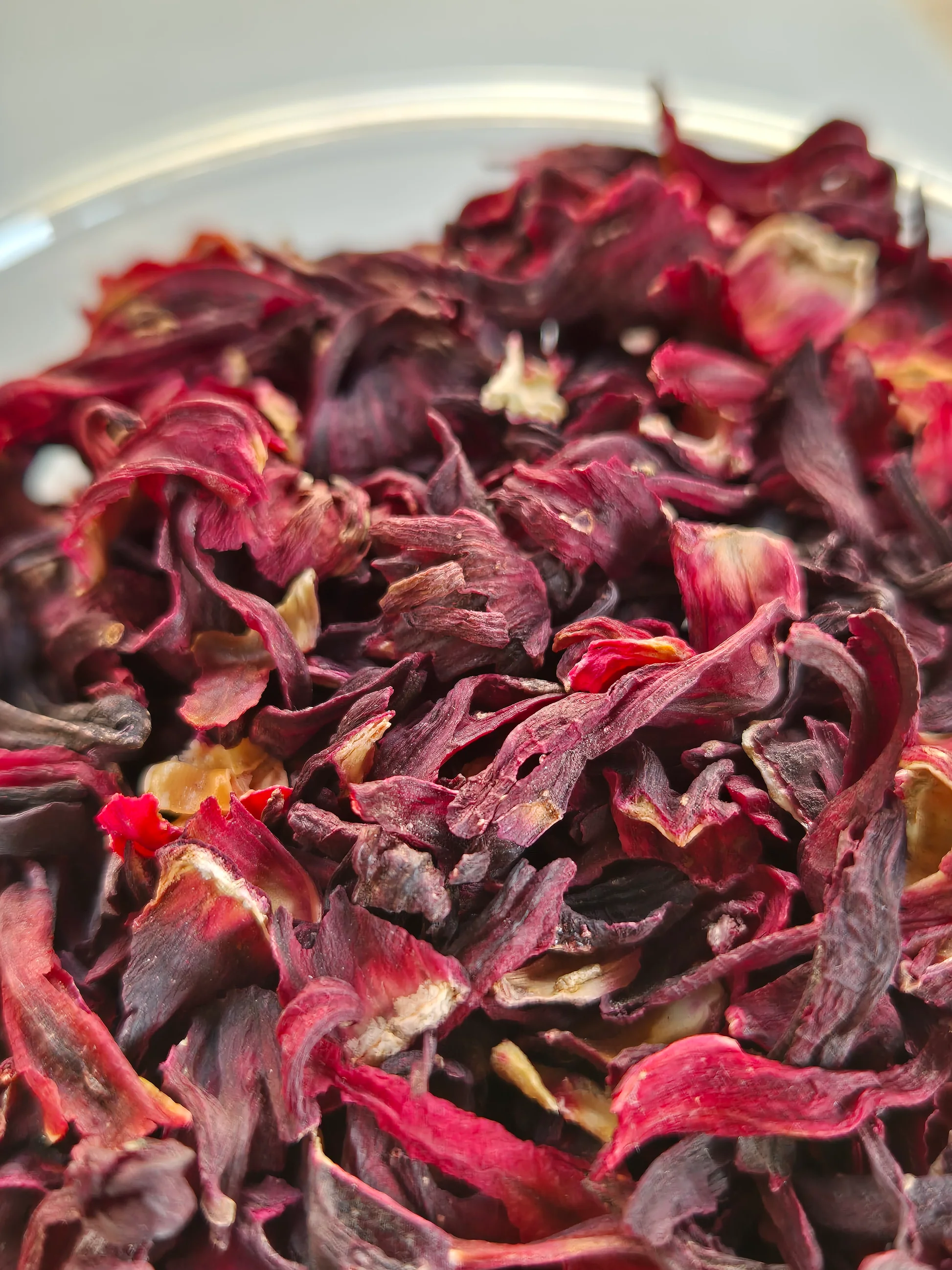
Dried hibiscus leaves (calyces) of Hibiscus sabdariffa L., sun-dried and sorted for colour consistency and purity. Harvested from mature calyces, separated from seed, sun-dried on raised beds, cleaned, sorted by colour and size, sieved, metal detected, and packaged. No additives or preservatives.
Côte d'Ivoire
Roselle
2025 / 2026
Food-grade
Dried hibiscus leaves (calyces) of Hibiscus sabdariffa L.
Hibiscus sabdariffa L. · Roselle variety · Family: Malvaceae
Food-grade · Sun-dried & sorted for colour; compliant with EU Reg. 2017/2470 and applicable herbal commodity standards
Harvesting, separation from seed, sun-drying on raised beds, cleaning, sorting by colour and size, sieving, metal detection, packaging
2025 / 2026 (current harvest, November–January)
Côte d'Ivoire
Northern regions · altitude 200–500 m.a.s.l.
Nature Commodities — sourced direct from partner cooperatives and smallholder farmers in Côte d'Ivoire
Whole or broken dried calyces; deep crimson to burgundy; free from foreign matter, insect damage or mould.
Deep red to dark crimson; uniform; indicative of high anthocyanin content; free from fading or discolouration.
Clean, characteristic hibiscus; slightly tart floral aroma; free from musty, fermented or foreign odours.
Vibrant, tangy and refreshing; characteristic tartness with subtle floral notes; rich in natural acidity.
Rich in antioxidants & vitamin C; naturally refreshing; no additives or preservatives.
| Parameter | Min | Max | UOM | Method |
|---|---|---|---|---|
| Moisture Content | — | 12.0 | % | ISO 662 / AOAC 934.01 |
| Water Activity (aW) | — | 0.60 | aW | Internal / AOAC |
| Total Anthocyanins | 1.5 | — | g/100g | pH differential (AOAC 2005.02) |
| Vitamin C (ascorbic acid) | 10 | — | mg/100g | HPLC / AOAC 967.21 |
| Total Acid (as citric acid) | 12 | — | % | Titration / internal |
| Crude Fibre | — | 18.0 | % | AOAC 978.10 |
| Ochratoxin A (OTA) | — | 10.0 | µg/kg | EN 14132 |
| Parameter | Limit | UOM | Method |
|---|---|---|---|
| Total Aerobic Plate Count | ≤ 1.0 × 10⁵ | cfu/g | ISO 4833 |
| Yeasts | ≤ 1.0 × 10³ | cfu/g | ISO 21527 |
| Moulds | ≤ 1.0 × 10³ | cfu/g | ISO 21527 |
| Enterobacteriaceae | ≤ 1.0 × 10² | cfu/g | ISO 21528-2 |
| Pathogen | Result | UOM | Method |
|---|---|---|---|
| E. coli | Absent | /g | ISO 16649-2 |
| Salmonella | Absent | /25 g | ISO 6579 |
Produced solely from hibiscus calyces. None of the following are present by direct addition or cross-contact:
Cereals containing gluten and derivatives
Crustaceans and derivatives
Eggs and derivatives
Peanuts and derivatives
Soy and derivatives
Milk and derivatives (including lactose)
Nuts and derivatives
Celery and derivatives
Mustard and derivatives
Seeds (Poppy, Sesame, etc.)
Lupine and derivatives
Molluscs and derivatives
Sulfur dioxide and sulphites ≥ 10 mg/kg
10 kg or 25 kg multi-layer kraft paper bags with food-grade polyethylene inner liner; hermetic sealing available on request.
10 kg or 25 kg per bag (as specified at order)
Approx. 10,000–14,000 kg net depending on bag format and stacking
Origin, lot number, harvest date, net weight, batch number, Fairtrade cert ref, Halal cert ref (where applicable)
Cool, dry, well-ventilated; 15–20°C, RH < 55%; away from direct sunlight, heat sources and strong odours.
Food-contact materials comply with EU Reg. 1935/2004 and 10/2011
Products do not fall within the scope of EU Regulations 1829/2003 and 1830/2003. No genetic modification techniques are used. Hibiscus is produced exclusively from naturally grown calyces — no GMOs as processing aids or additives. All hibiscus is fully traceable, unadulterated, and not substituted with any other raw material.
Ethically sourced natural commodities — from farm to shelf, rooted in sustainability and quality.
Copyright © Nature Commodities, 2025